


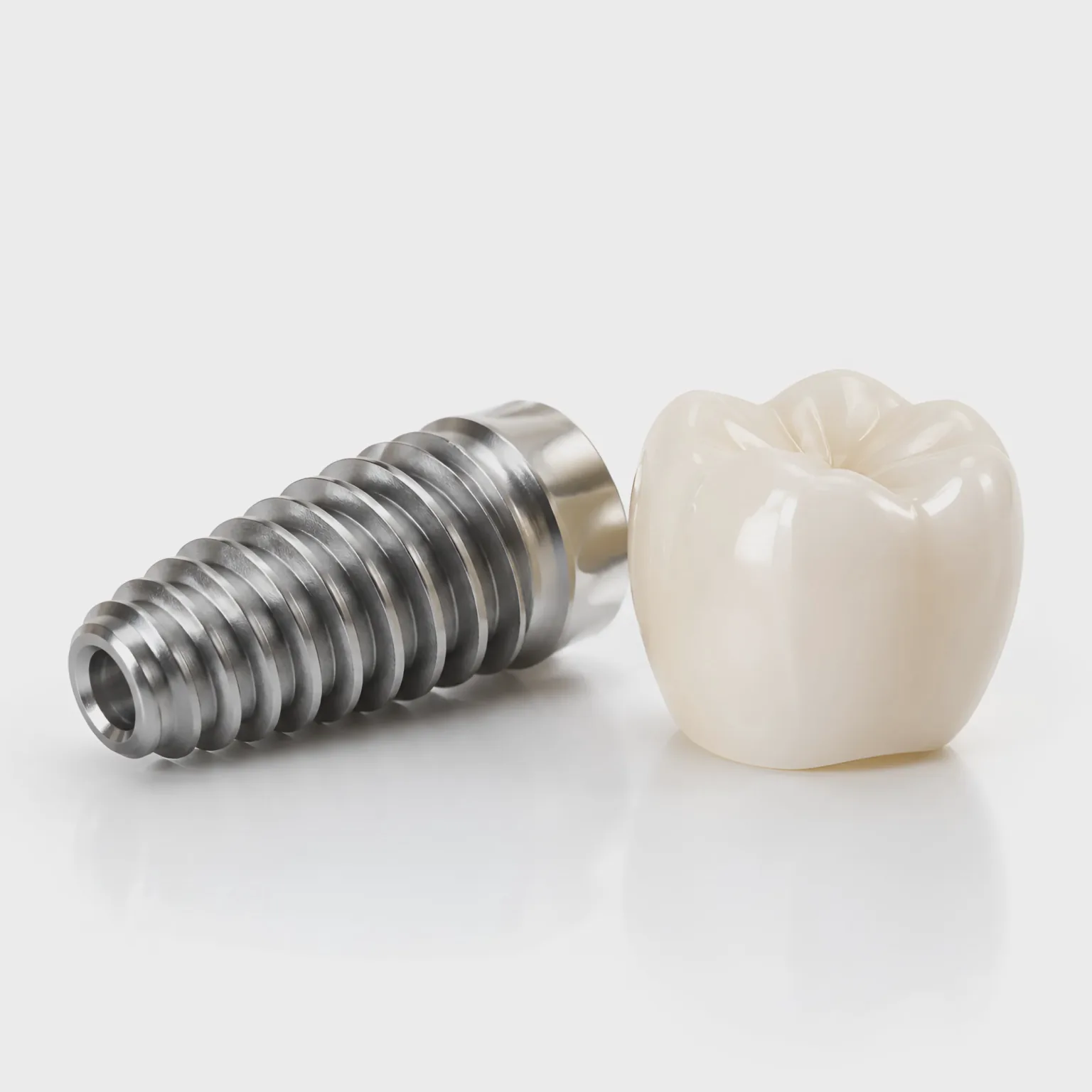
What All-on-6 costs in Temecula
Both describe replacing a full arch of teeth with a fixed prosthesis. The difference is how many implants carry it, and that single number drives most of the cost gap between the two.
Paris Dental places All-on-6 for full-arch cases, from $18,995 per arch, including surgery and prosthesis. We do not place All-on-4. This page compares the two anyway, because patients arrive having been quoted All-on-4 elsewhere and deserve to understand what they are comparing.
| All-on-4 | All-on-6 (what Paris Dental places) | |
|---|---|---|
| Implants per arch | 4 | 6 |
| Surgical component | 4 implant fees | Included in $18,995 from |
| Prosthesis | Separate at many practices | Included in the figure above |
| Rear implants | Angled to avoid grafting | Placed where bone allows |
| Load distribution | Across 4 points | Across 6 points |
| Bone requirement | Lower | Higher, or grafting first |
| Starting price here | Not offered | from $18,995 per arch |
The components that move you above $18,995 are the same for either approach, and they are itemised in the next section rather than buried in a total.
Prices last updated 7 November 2026. See the full treatment price list for every fee we publish.
What a full-arch case involves
A full arch replaces every tooth in the upper or lower jaw with a fixed prosthesis carried on implants. All-on-6 uses six; All-on-4 uses four and angles the rear pair to avoid the sinus and nerve. Both are legitimate approaches and the choice depends on bone volume, bite forces and anatomy.
The treatment usually includes:
- Comprehensive examination and 3D imaging
- Treatment planning, sometimes with a surgical guide
- Any needed extractions
- Possible bone grafting or sinus procedures
- Placement of four implants per arch
- A temporary prosthesis during healing
- A final fixed prosthesis after integration
- Follow-up visits and maintenance
Each of those lines is a cost centre. Quotes that omit some of them are not cheaper; they are incomplete.
What the estimate looks like, line by line
A written estimate for one arch should read as a list of separate decisions, not a single total. Here is the skeleton, with the parts Paris Dental publishes filled in and the parts that require imaging marked as such.
| Line | Basis | Status for a one-arch case |
|---|---|---|
| Examination and treatment plan | $195 fixed | Published |
| 3D imaging | Not included in the examination fee | Charged separately when required |
| Extractions | from $395 per tooth | Published; surgical extractions higher |
| Bone graft, if needed | After imaging | Quoted per site |
| Sinus lift, if needed | After imaging | Quoted per side |
| Implant placement | $1,895 per implant | Published |
| Six implants, one arch | Included in the arch fee | $18,995 from |
| Temporary prosthesis | After imaging | Quoted |
| Final prosthesis | After imaging | Quoted — usually the largest single line |
| Sedation, if requested | Per session | Quoted |
| Follow-up and adjustments | Per visit or bundled | Confirm which |
The only figure that can be stated before you are examined is the surgical component, because it is a per-implant price multiplied by a known quantity. Everything below it in that table depends on anatomy or on a choice you have not made yet.
Use the table as a checklist. If a quote you receive collapses several rows into one number, ask which rows are inside it.
When the second arch changes the math
Most published full-arch prices describe one arch. Patients often assume the figure covers the whole mouth, then discover the quote doubles.
Two arches is not simply twice the cost. It is close to twice the surgical component, because that is a per-implant price and the implant count doubles. The prosthetics, however, do not scale identically: a second arch means a second temporary, a second final prosthesis, and usually a second set of extractions and grafting decisions.
If you need both arches, ask for the estimate split into upper and lower from the start. Combining them into one total makes it impossible to compare against a practice that quotes per arch, and most do.
If only one arch is failing, treating it alone is a legitimate plan. There is no obligation to replace a healthy arch, and a practice that pushes both without a clinical reason is selling rather than treating.
Maintenance costs over ten years
The treatment fee is the entry cost, not the lifetime cost. Budget for these separately.
Hygiene. Implant-supported prostheses need professional cleaning more often than natural teeth in many cases, because the junction between prosthesis and gum is where problems start. Plan for three to four visits a year rather than two.
Prosthesis wear. Acrylic and composite surfaces wear and stain. They may need replacement or refinement well before the implants do. A milled or titanium-reinforced prosthesis typically lasts longer but costs more initially.
Hardware. Screws loosen. Occasionally a component fractures. These are small costs individually and worth asking about before you commit.
The implants themselves. A well-placed implant in a non-smoking patient with good hygiene can last decades. That is the outcome the fee is buying, and it is why implant brand and surgical planning matter more than the headline price.
Ask any practice what the annual maintenance cost looks like in years three, five and ten. A practice that can answer has thought about the lifetime of the treatment.
Upcharges to watch for in a low quote
A quote well below the local range is not automatically dishonest. It is, however, usually quoting a different scope. These are the gaps that show up later.
Per-arch versus per-implant. A "starting at" figure may describe a single implant, not a full arch. Check the unit.
Provisional only. Some quotes cover the temporary prosthesis and describe it as the final. Ask when the definitive teeth are fitted and whether they are included.
Excluded extractions. If you need eight teeth removed and the quote excludes them, the real total is several thousand dollars higher than the number you were shown.
Grafting deferred. Grafting quoted as "if needed" may be near-certain in your case. Ask for an estimate assuming it is needed, then one assuming it is not.
Sedation excluded. Long surgical appointments often warrant sedation, which carries its own fee.
Follow-up billed per visit. Post-operative care that is bundled elsewhere can arrive as a series of invoices.
Narrow implant system. A less common implant system can be harder and more expensive to restore later by a different clinician.
None of these make a cheap quote wrong. They make it incomplete, and an incomplete quote cannot be compared to a complete one.
Comparing All-on-6 with a conventional denture
These are three genuinely different treatments, not three prices for the same thing.
| All-on-4 | All-on-6 | Conventional denture | |
|---|---|---|---|
| Implants per arch | 4 | 6 | None |
| Fixed or removable | Fixed | Fixed | Removable |
| Surgical component | Four implant fees at most practices | Included in the from $18,995 | None |
| Bone requirement | Lower — angled implants | Higher | None |
| Grafting likelihood | Lower | Higher | N/A |
| Healing before final teeth | 8–12 weeks | 8–12 weeks | None |
| Removable for cleaning | No | No | Yes |
| Bone preservation | Yes, implants load the bone | Yes | No — ridge shrinks over time |
| Lifespan of the prosthesis | Long, with maintenance | Long, with maintenance | Shorter, needs remaking |
All-on-6 places two more implants than All-on-4. At this practice the arch fee covers all six plus the prosthesis, so the comparison that matters is the total per arch, not the implant count alone. It suits patients with adequate bone who want more support across the arch. All-on-4 exists precisely because many patients do not have that bone, and angling the rear implants avoids grafting they would otherwise need.
Paris Dental places All-on-6. All-on-4 appears on this page because patients arrive holding quotes for it, and comparing the two is the point. Ask any clinic directly which procedures it performs in house and which it refers.
A denture is the lowest-cost option and remains the right answer for some patients — particularly where surgery is contraindicated, or where the priority is a removable appliance at minimum cost. It is not a failure to choose it. It is a failure to choose it without being told the others exist.
How to read a competitor's price claim
Local implant advertising tends toward two shapes: a low "starting at" figure, and a "free consultation" with the price arriving later.
Ask what the starting figure buys. Frequently it is a single implant, or the surgical component only, or a promotional rate conditional on accepting a treatment plan on the day.
Ask for the arch total in writing. A practice that will not put an itemised arch total in writing before you commit is telling you something about how the estimate will evolve.
Ask whether the final prosthesis is included. This is the single largest source of quote divergence and the most common omission in a headline figure.
Compare like with like. A $12,000 arch that excludes the final prosthesis is not cheaper than a $20,000 arch that includes it. It is a different product with a smaller number attached.
The honest comparison is two itemised written estimates, side by side, with the same rows filled in. Anything less is comparing marketing to medicine.
The factors that drive the price
Number of arches. One arch costs less than two. Some quotes quote only the upper or lower, which is a common source of confusion when comparing totals.
Extractions. Retaining hopeless teeth requires surgical removal, sometimes with bone grafting to preserve ridge volume. Multiple extractions add time, surgical complexity, and cost.
Bone grafting. If ridge volume is insufficient, grafting may be required before or during implant placement. This is common and adds a distinct line item. Some cases need a sinus lift.
Implant brand and components. Implant systems vary in cost and in long-term component availability. Ask which system is used and whether replacement parts will be available years from now.
Prosthesis material. An acrylic provisional is less expensive than a milled titanium-reinforced final prosthesis. The material affects durability, aesthetics, and replacement interval.
Temporary versus final teeth. A provisional allows you to function and heal. The final prosthesis is a separate, more substantial cost. Quotes that include only one of these are incomplete.
Sedation or anaesthesia. Intravenous sedation, oral sedation, or general anaesthesia each carry separate fees. Complex or lengthy cases often warrant sedation.
Laboratory and technician quality. The aesthetic and functional outcome depends heavily on the laboratory. A cheaper laboratory quote often reflects different materials and less individualisation.
Practice and clinician factors. Specialist involvement, surgical experience, technology, and location all influence fees. These are legitimate differences, not automatically markup.
Follow-up and maintenance. Post-operative visits, adjustments, and hygiene support may or may not be bundled.
Why quotes differ so much
Two quotes for "full arch" can differ by a factor of three and both be internally accurate. The difference is what each includes.
| Component | Sometimes included | Sometimes excluded |
|---|---|---|
| Consultation and 3D imaging | Yes | Charged separately |
| Extractions | Yes | Per tooth |
| Bone grafting | Yes | Quoted after imaging |
| Temporary prosthesis | Yes | Separate |
| Final prosthesis | Yes | Separate, often the largest line |
| Sedation | Yes | Separate |
| Follow-up visits | Yes | Per visit |
| Maintenance plan | Yes | Not offered |
When you receive a quote, ask for the itemised breakdown and confirm which of these are inside the total. A higher quote that includes the final prosthesis may be substantially less expensive than a lower quote that does not.
Be cautious of "teeth in a day" marketing that implies a permanent result on the day of surgery. What is usually placed on the day of surgery is a temporary prosthesis. The final teeth come later, after healing.
What to ask before committing
Bring these questions to a consultation. A practice that answers them clearly and in writing is a practice worth considering.
- How many implants are included, and in which arch?
- Are extractions included, and how many?
- Is bone grafting anticipated, and is it included or quoted separately?
- What is placed on the day of surgery, and when are the final teeth delivered?
- What material is the final prosthesis made from?
- Which implant system, and is it widely supported?
- Is sedation included?
- What does follow-up include, and for how long?
- What is the maintenance schedule and cost?
- What happens if an implant fails, and what is the warranty or replacement policy?
- Can I see examples of similar cases?
- Can I have the full itemised estimate in writing before I decide?
If any answer is vague, treat that as information about how the practice operates.
Insurance and financing
Dental insurance rarely covers a large share of full-arch implant treatment. Typical limitations include an annual maximum, exclusions for implants, and requirements for alternative treatments to be attempted first. Some plans cover extractions and a denture but not implant-supported prosthetics.
Ask the office to run a benefits check against your specific plan, not just the carrier name. Network status and plan terms vary within a single insurance company.
Financing options commonly include third-party medical financing, in-house payment plans, and membership-style maintenance arrangements. Request the terms in writing, including any interest, fees, and the effect of missed payments.
Is a full-arch approach the right choice at all?
Cost only matters after the treatment is right. A full-arch implant prosthesis is one option among several for a failing or fully edentulous arch. Others include:
- Implant-supported overdenture — removable, uses fewer implants, lower cost, different maintenance profile.
- Conventional complete denture — lowest cost, removable, no surgery, different function and comfort.
- Individual implants with a bridge — more implants, higher cost, appropriate in some cases.
- Retaining selected teeth with a partial — if some teeth remain healthy and strategic.
Each has different indications. The correct choice depends on bone volume, medical history, aesthetic goals, function, and budget. A consultation should compare options honestly rather than steer toward one treatment.
What happens if you delay
Untreated failing teeth can progress to infection, bone loss, and changes in the shape of the jaw. Bone that is lost over time may require more extensive grafting later, which adds cost and complexity.
Delaying is sometimes reasonable for financial or medical reasons, but it should be a deliberate decision after a clinical assessment rather than a default. Ask what is likely to change if you wait six or twelve months.
Your next step
The only way to get an accurate full-arch price is an examination with 3D imaging and a written, itemised plan.
Contact Paris Dental or call (951) 577-8090 to discuss full-arch implant options at 31285 Temecula Pkwy Ste 205, Temecula, CA 92592, United States. We are open Monday through Friday, 9:00 am to 5:30 pm.
For more detail, read our guide to the dental implant process and our full-arch treatment overview.
General information does not replace an individual examination. Treatment suitability, risks, and costs must be confirmed for your specific case.
Common questions
How much does full-arch implant treatment cost in Temecula?
At Paris Dental, full-arch treatment means All-on-6, which starts at $18,995 per arch and includes both the implant surgery and the fixed prosthesis. Extractions, bone grafting and sinus lifts are priced separately because they depend on your anatomy. You get an itemised written estimate before treatment begins.
Why do full-arch quotes differ so much between offices?
Quotes differ because they often describe different treatment. One may include extractions, bone grafting, temporary teeth, and the final prosthesis; another may cover only implant placement. Brand of implant, laboratory quality, sedation, and follow-up visits also change the total. Always compare itemised breakdowns, not totals.
Does dental insurance cover full-arch implants?
Coverage is usually limited. Many plans contribute toward extractions or a denture but exclude or cap implant benefits. Some plans have an annual maximum that covers only a fraction of the total. Ask the office to verify your specific plan in writing before treatment planning proceeds.
Is a full-arch approach cheaper than individual implants?
Yes, usually. A full-arch prosthesis is carried on six implants rather than one implant per missing tooth, so the total is generally lower than replacing sixteen teeth individually. It is still a different treatment with different indications, not a discount version of the same thing.
Can I finance full-arch implant treatment?
Many practices offer third-party financing or in-house payment plans, and some offer membership-style arrangements for maintenance. Ask what is available, what the terms are, and whether there are interest charges. Get the financing terms in writing alongside the treatment estimate.
What ongoing costs should I expect afterwards?
Plan for professional maintenance visits, periodic imaging, and possible replacement of worn prosthetic components over time. Implant hardware generally lasts many years, but the prosthesis and its attachments experience wear. Ask what maintenance interval the practice recommends and what those visits typically cost.