


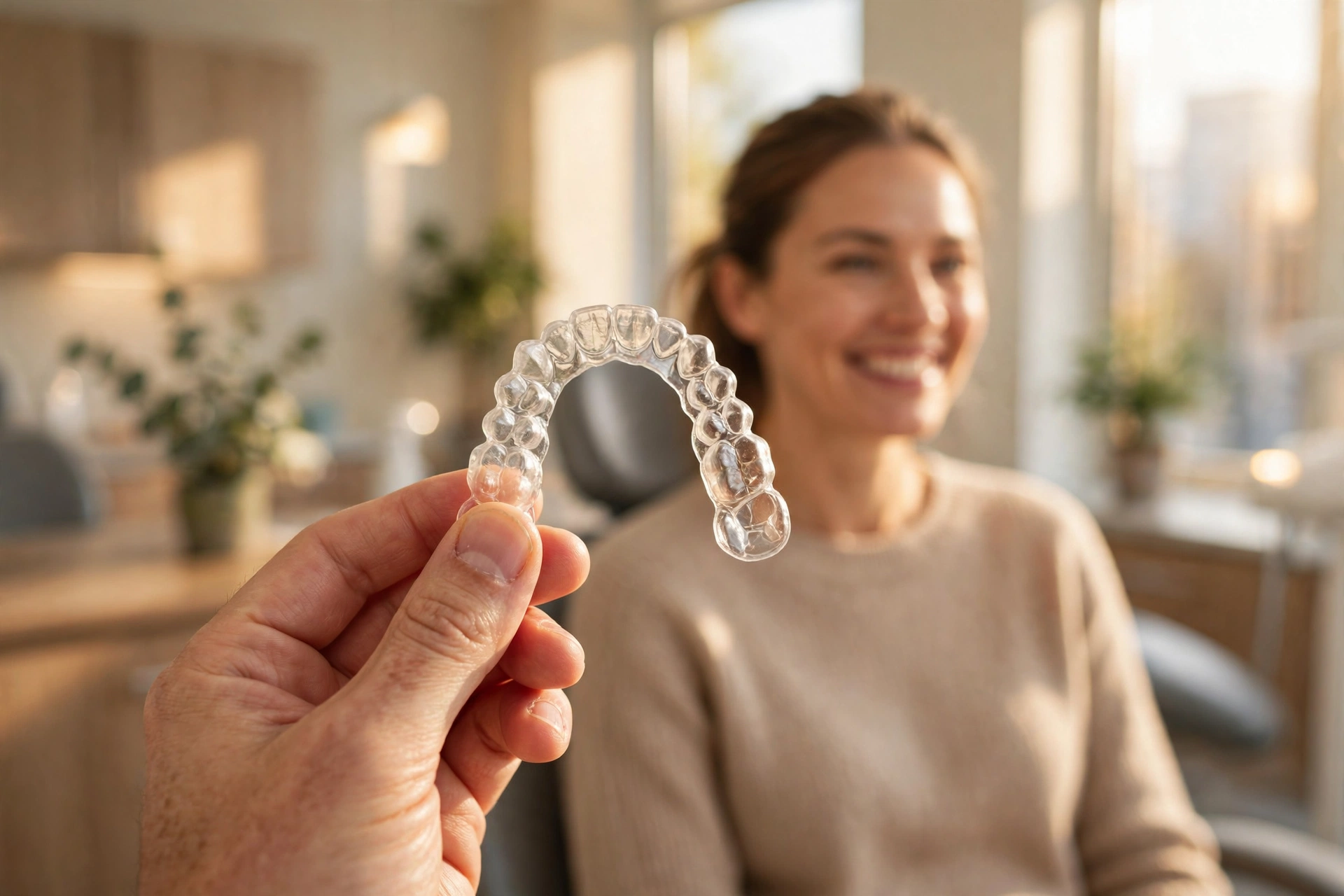
Yes. Paris Dental in Murrieta offers Invisalign clear aligners and orthodontic planning for teens and adults. Treatment begins with an examination and digital imaging to map your tooth movement. Call (951) 577-8090 to see if clear aligners suit you.
Care built around you
Orthodontics is about more than a straighter smile — aligned teeth are easier to clean, bite forces distribute more evenly, and long-term wear decreases. At Paris Dental in Murrieta, Dr. Noorullah Azim offers both traditional braces and clear aligner treatment, and recommends an approach only after an examination and appropriate imaging. If your case needs a specialist orthodontist, referrals are recommended when specialist care is appropriate.
Is this the right care for me?
- Your teeth are crowded, spaced, or visibly crooked
- Your bite feels off, or your jaw tires when chewing
- You had orthodontics before and your teeth have shifted
- You want a discreet option like clear aligners for work or school
- Your child has been recommended for an orthodontic evaluation
Braces and clear aligners: orthodontic options in Murrieta
Traditional braces remain the most versatile orthodontic tool. Modern brackets are smaller and more comfortable than the versions many adults remember, and they give precise control over complex tooth movements and bite correction. For teens and for cases involving significant rotation or bite issues, braces are often the ideal recommendation.
Clear aligners, including Invisalign treatment, offer a removable alternative that many adults and image-conscious teens prefer. The aligners are nearly invisible, come out for eating and brushing, and typically mean fewer in-office visits. They work best when worn as directed — usually most of the day — so honest self-assessment matters when choosing.
Some patients benefit from a combined approach: braces for a phase of complex movement, then aligners to refine. Whatever path fits, the plan is built around your teeth, your bite, and your life — not a one-size template. Feel free to ask as many questions as you need during your consultation; understanding the trade-offs is how you make a confident choice.
Orthodontics for teens and adults
Teen treatment often focuses on guiding growth while teeth are still settling, which can simplify correction. Adult treatment works with a mature bite and frequently pairs alignment with restorative plans — straightening first, then crowns or implants placed into ideal positions. Both age groups succeed when the plan respects biology rather than rushing it.
For adults concerned about appearance during treatment, clear aligners or tooth-colored braces keep things discreet. For teens, we talk frankly about responsibility: aligners only work if they are worn, and braces only work if hygiene stays strong. The right choice is the one you will actually follow through on.
Whatever your age, the first step is the same: a consultation where we map your bite, discuss options honestly, and give you a written plan. No pressure, no obligation — just a clear picture of what orthodontics could do for you.
Clear aligner treatment, step by step
Clear aligner treatment begins with a digital scan of your teeth — no goopy impressions. That scan becomes a 3D model, and specialized software maps each tooth's planned movement from start to finish. You will actually see the projected result before committing, which helps set honest expectations about what aligners can and cannot do for your bite.
Once your custom aligner series is made, you wear each set for one to two weeks as directed, switching on schedule. Each aligner nudges teeth slightly closer to the plan. Most patients visit us every six to eight weeks so we can verify tracking — that the teeth are following the digital plan — and hand over the next sets.
The discipline is the treatment. Aligners work only while worn, so the twenty-plus hours a day they spend in your mouth is what buys the result. Patients who follow the wear schedule finish on time; those who do not, do not. We are candid about this at the consultation because aligner success is genuinely a partnership.
Most aligner cases include a refinement phase — a short series of additional aligners that fine-tune the result after the initial series. This is normal and planned for, not a sign something went wrong. Your projected timeline accounts for it, and refinements are discussed before you ever start.
Your visit: consultation and treatment planning
We begin with your health history, concerns, and an examination. Dr. Azim explains the findings, appropriate options, expected visits, and estimated costs before treatment begins. For orthodontic planning, appropriate imaging and measurements map your bite so the projected tooth movements are based on data, not guesswork. Timing and suitability depend on your examination. Referrals are recommended when specialist care is appropriate.
Living with orthodontic treatment
Day-to-day life with braces means a few adjustments: softer foods at first, careful brushing around brackets, and avoiding anything that can break a wire. With aligners, the discipline is different — wear them as directed, remove them to eat, and keep them clean. Both paths reward consistency, and our team checks your progress at regular visits.
Soreness after adjustments or a new aligner set is normal and short-lived. Orthodontic wax, a soft diet for a day or two, and patience handle most of it. If a bracket breaks or an aligner cracks, call us rather than waiting for your next visit — small problems are easiest to fix early, and we keep time in the schedule for exactly that.
School, sports, and work all continue normally during treatment. Athletes should ask us about mouthguards that fit over braces. Musicians, public speakers, and anyone whose livelihood involves their mouth deserve a frank conversation about adaptation time — we have it with you before you commit.
Adjustment visits for braces typically run every four to eight weeks. At each visit we assess progress, change wires or elastics as the plan requires, and address any discomfort. These visits are short — most patients are in and out within half an hour — but they are where the precision happens.
Retainers: holding your result
Teeth remember where they used to be. Without retention, even a beautifully finished case can drift. That is why every orthodontic plan at our office includes a retainer strategy — fixed, removable, or both — discussed before treatment even starts.
Retention deserves the same seriousness as active treatment. In the first months after braces come off or the last aligner is worn, the bone around the teeth is still stabilizing — this is when drift happens fastest. Fixed retainers bonded behind the front teeth work around the clock without thought; removable retainers work when worn, especially at night. Many patients use both, and the combination is often ideal.
Wear your retainers as directed, especially in the first year. They are the quiet insurance policy on everything you invested in the active phase. If a retainer is lost or stops fitting, tell us promptly rather than hoping it resolves on its own — every week without it invites movement, and re-treatment costs far more than a replacement.
Plan with confidence
Ask for a written treatment estimate and confirm insurance benefits or membership eligibility before proceeding. Many PPO plans include an orthodontic benefit, and our team verifies coverage in advance. Explore payment options or request an appointment. Paris Dental is located at 24837 Jefferson Ave, Suite 206, Murrieta, CA 92562 — call (951) 577-8090 to schedule your consultation.